Introduction to Modern File Tracking Technologies
In today's digital age, traditional paper-based file tracking methods are increasingly inadequate for organizations dealing with large volumes of documents. RFID (Radio-Frequency Identification) and barcode technologies have emerged as powerful solutions for automated file tracking, offering real-time visibility, enhanced security, and improved operational efficiency.
These technologies transform file management from manual, error-prone processes to automated, reliable systems that provide instant access to critical information. By implementing RFID and barcode solutions, organizations can significantly reduce the time spent searching for files and performing inventory and audits, minimize loss and misplacement, and ensure regulatory compliance.
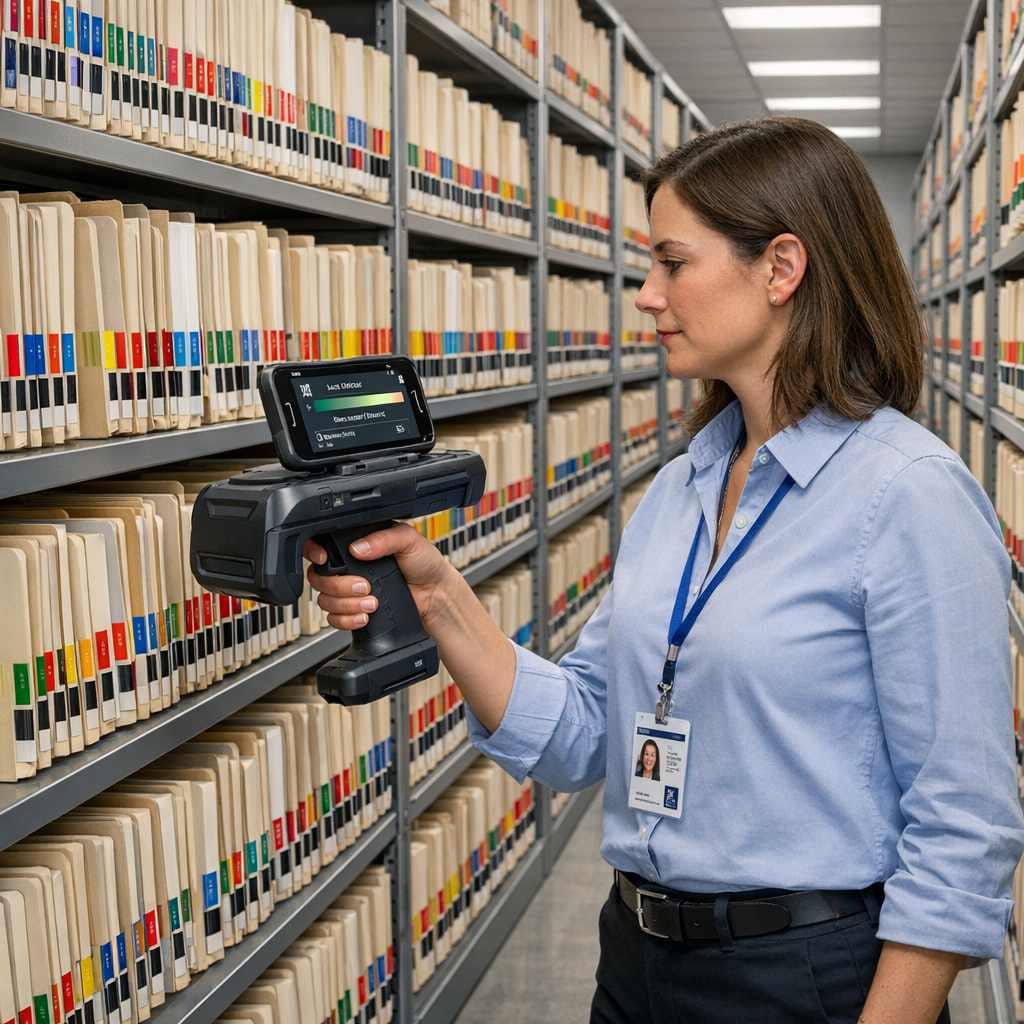
Table of Contents
Understanding RFID Technology for File Tracking
RFID technology uses electromagnetic fields to automatically identify and track tags attached to objects. In file tracking applications, RFID tags are affixed to folders, boxes, or individual documents, enabling seamless monitoring of their location and movement. The RFID tags also enable quick checkin and checkout operations. File or Documents or archives can be quickly scanned with handheld RFID readers and can be quickly transferred to other personnel or locations. These points will be discussed in detail in the following sections.
How RFID Works
RFID systems consist of three main components: tags, readers, and software. Tags contain microchips that store unique identification data. Readers emit radio waves to detect and read tag information without requiring line-of-sight. The software processes the data and provides real-time visibility into file locations and status.
RFID Tag Types for File Tracking
- Passive Tags: Cost-effective, powered by reader energy, ideal for most file tracking applications. They have longer lifespan as they don't use a battery to power them. They are a very cost effective option. They can be easily labelled with barcodes for additional tracking. The lower price per tag makes using of passive RFID systems economical for file tracking applications. Passive RFID labels can be printed quickly and economically with an RFID printer and can be placed directly on an file or document or archive.
- Active Tags: These tags contain their own internal battery. Since they have battery power, they can broadcast signals over longer distances to nearby readers, making them more suitable for asset tracking in large facilities. They are more expensive than passive tags and have a limited lifespan due to battery life. They are not commonly used for file tracking applications. They are expensive tags and their size is large making them not very practical for file tracking systems. The businesses typically have thousands to several thousand files or millions of files in larger organizations, making the use of active tags impractical.
- Semi-Passive Tags: These are are a hybrid between passive RFID and active RFID. They are also called Battery Assisted Passive tags. They combine benefits of both passive and active tags for specialized applications. They contain a battery but they don't braodcast signals continuously like Active tags. They remain silent until interrogated by a reader. The battery is used to power the tag's circuitry during communication with the reader. How it works
- The reader emits a radio signal.
- The tag detects the signal.
- The tag's circuitry is powered by its internal battery.
- The tag responds back to the reader.
Where Can RFID Technology Be Used In File Tracking?
- Quick Check-in and Check-out:
Files or documents or archives tagged with RFID tags can be quickly scanned with handheld RFID readers for quick transfer to other personnel or locations. This ensures that transaction is performed quickly and all data related to transfer transaction is accurately recorded in system. Systems record transaction data in audit trail for compliance and audit purposes.
- Real-Time Location Tracking:
RFID readers can be installed at strategic locations to monitor the movement of files between departments. Whenever the items move from one location to another, the system updates location of each file in real-time. This helps in maintaining accurate records and ensures that files are always traceable. The RFID desk readers can also be installed at desks to update the location of item. Mostly used locations can be covered with desk readers to track most recent location of records
- Quick Inventory:
RFID technology enables quick inventory of items using RFID handheld readers. This saves over 85% of time as compared to doing it manually
- Quick Audits:
RFID technology enables quick audit of a particular location using RFID handheld readers. Quick audit ensures that all files are accounted for and helps in maintaining accurate records. If any item is missing at a particular location, system will provide a complete report and can send automatic alerts
` - Automate Processes:
Automate check-in and check-out processes using RFID readers at record rooms. Records exiting the area are marked checked out automatically, reducing manual intervention and errors. Similarly records entering records room are marked checked in automatically. This process needs to be designed properly so that personnel details are also captured along with item details to maintain complete audit trail.
- Prevent Exit Of Sensitive Files:
RFID readers installed at exit doors can detect sensitive files and create alerts if those files are marked as sensitive and are not supposed to leave the facility. This helps in preventing sensitive information from falling into wrong hands and ensuring that files are not compromised. The system can be designed to create audio and visual alerts.
- Prevent Exit Of Unauthorized Files:
RFID readers installed at exit doors can detect unauthorized files and create alerts. If the files being removed are not authorized for removal, the system can be designed to create audio and visual alerts to prevent unauthorized removal of files. This helps in preventing loss of files.
- Reduce Manual Errors:
The operations like Checkin, Checkout, Inventory and Audits are automated using RFID technology, which helps in reducing manual errors. The system automatically captures all data related to these operations and maintains a complete audit trail, which helps in ensuring data integrity and accuracy.
Advantages of RFID for File Tracking
- Automation: No manual scanning required - files are tracked automatically as they move from office to office or between departments. By putting readers at strategic locations, the system can automatically update the status and location of each file.
- Bulk Reading: RFID tags can be read in bulk by readers. Multiple files can be read simultaneously making the process more efficient.
- Real-Time Tracking: The readers installed at strategic locations enable continuous monitoring of file locations and movements
- Durability: UHF RFID tags are durable and can withstand little tough environments, making them suitable for long-term use
- Security: Automatic location tracking and audit trail logging ensure the integrity and security of files. The readers installed at exits doors cant detect unauthorized removal of files and create alerts.
- Compliance: Helps in maintaining regulatory compliance by providing accurate records of file movements and access.
- Cost Savings: Reduces labor costs associated with manual tracking and minimizes losses due to misplacement or theft.
- Scalability: Easily scalable to accommodate growing volumes of files and expanding operations.
Barcode Technology in File Tracking
Barcode technology, while more traditional than RFID, remains a viable and cost-effective solution for many file tracking applications. Barcodes use optical machine-readable patterns to encode data that can be scanned using various devices.
Types of Barcodes for File Tracking
- 1D Barcodes: Traditional linear barcodes like Code 128, suitable for basic identification
- 2D Barcodes: QR codes and Data Matrix, capable of storing more information
- Custom Labels: Specialized barcode labels designed for document management
Barcode Scanning Methods
- Dedicated Scanners: Handheld or fixed barcode readers for high-volume applications. In case of fixed barcode scanners, the items should move in a certain direction and orientation to ensure accurate scanning. If barcode is not in proper alignment with scanner, it may result in scanning errors.
- Smartphone Cameras: Cost-effective using existing mobile devices
- Integrated Systems: Barcode scanners built into file cabinets or workstations. Here also, the items should move in a certain direction and orientation to ensure accurate scanning. These issues arise with barcode scanning because of the need for line-of-sight and proper alignment for accurate scanning.
Benefits of Barcode Technology
- Cost-Effective: Lower implementation costs compared to RFID
- Reliability: Proven technology with high accuracy rates
- Compatibility: Works with existing smartphones and devices
- Flexibility: Can encode various types of information
- Simplicity: Easy to understand and implement
RFID vs Barcode: Choosing the Right Technology
The choice between RFID and barcode technology depends on specific organizational requirements, budget constraints, and operational needs. Each technology offers unique advantages and may be suitable for different aspects of file tracking.
When to Choose RFID
- High-volume file processing with frequent movements
- Need for hands-free, automated tracking
- Large storage facilities with multiple locations
- Requirements for real-time inventory and location data
- Budget allows for higher initial investment
When to Choose Barcode
- Cost-sensitive applications with limited budget
- Manual scanning processes are acceptable
- Integration with existing mobile devices
- Simpler implementation requirements
- Small scale operations
Hybrid Approaches
Many organizations benefit from combining both technologies. For example, using barcodes for operations like checkin and checkout and RFID for automated circulation tracking, inventory and audit operations. This approach leverages the strengths of both systems while optimizing costs and functionality.
Implementation Considerations
Successful implementation of RFID or barcode file tracking requires careful understanding of the requirements, proper planning and consideration of various factors e.g. cost, training, manpower availability, infrastructure, and scalability.
Technology Selection
Deciding on Technology is not easy decision. You need to consider operational requirements, budget constraints, and specific needs of your organization. If you do inventory operations very regularly to keep the status of files updated, RFID is more suitable due to its rapid read and automation capabilities. Same goes for audit operations. But if the need is just to capture accurate data during checkin and checkout operations, barcode technology is enough for that. If you are looking for complete automation of checkin and checkout processes, RFID is the choice. You can automate checkin and checkout processes with RFID. These decisions are critical decisions before you start any technology project.
Infrastructure Requirements
- Hardware: Readers, scanners, tags, and networking equipment
- Software: Tracking platform, mobile apps, and reporting tools
- Integration: Compatibility with existing document management systems
Staff Training and Change Management
Provide comprehensive training to all users and develop change management strategies to ensure smooth adoption. Address concerns about job security and demonstrate the benefits of the new system.
Cost-Benefit Analysis
Calculate ROI by considering time savings, reduced file loss, improved efficiency, and compliance benefits. Most organizations see positive returns within 12-18 months of implementation.
Benefits of Automated File Tracking
Implementing RFID or barcode technology delivers significant improvements across multiple areas of file management.
Operational Efficiency
- Reduced Search Time: Adoption of RFID or barcode technology significantly reduces the time spent searching for files. The real-time visibility of file locations allows staff to quickly locate and retrieve documents.
- Automated Processes: Streamlined check-in/check-out, quick inventory and audit operations, and automated tracking of file circulation
- Error Reduction: Minimized manual data entry and transcription mistakes
- Productivity Gains: Staff can focus on core tasks rather than administrative work
Enhanced Security and Compliance
- Audit Trails: Complete digital records of file movements and access
- Access Control: Role-based permissions and security protocols
- Secure Chain of Custody: Tamper-evident tracking for legal and regulatory compliance
- Loss Prevention: Real-time alerts for if unauthorized files are removed from office premises. Sensitive documents can be tracked and protected accordingly. System can be configured to disallow their removal from office.
Improved Decision Making
- Real-Time Analytics: Data-driven insights into file usage patterns
- Usage Reports: Comprehensive reporting for management and compliance
- Performance Metrics: Measurable improvements in efficiency and accuracy
- Trend Analysis: Historical data for process optimization
Conclusion
RFID and barcode technologies represent a significant advancement in file tracking, offering organizations automated, efficient, and secure solutions for document management. Whether choosing RFID for its automation capabilities or barcode for its cost-effectiveness, these technologies provide substantial improvements over traditional manual methods.
The key to successful implementation lies in understanding your organization's specific needs, selecting the appropriate technology, and ensuring proper training and change management. With the right approach, RFID and barcode file tracking can transform your document management operations, leading to improved efficiency, enhanced security, and better compliance.
Ready to Get Started?
Contact GOBO Systems to learn how RFID and barcode technologies can revolutionize your file tracking processes. Schedule a consultation today and discover the perfect solution for your organization.
You can also go through GOBO File and Document Tracking System to learn more about capabilities of File Tracking System